
Posted on February 9, 2026 by Sean M. Wood
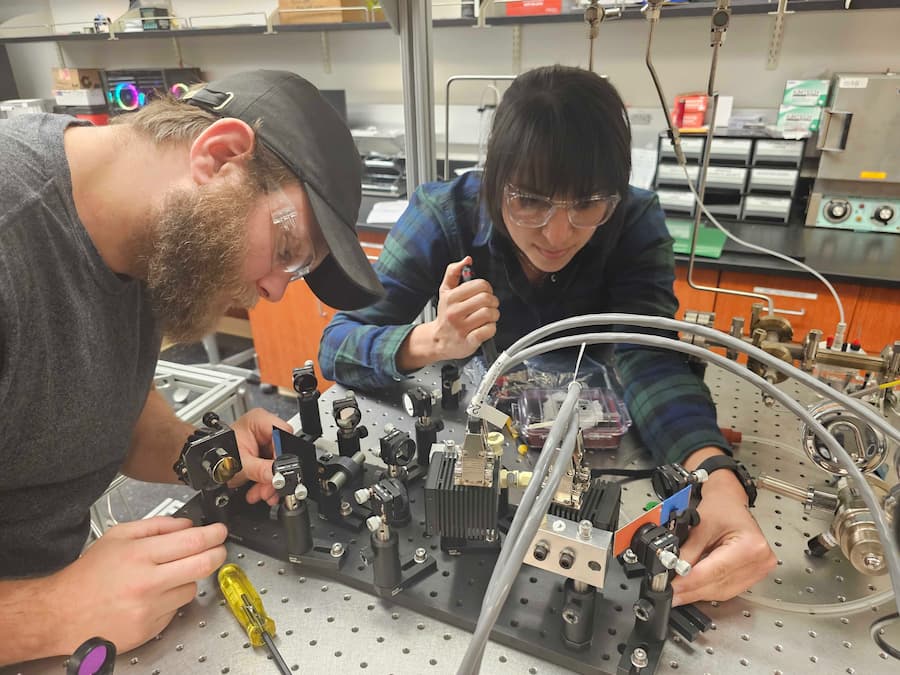
Krystal Martinez working on an engineering project.
What do a mule, a farming village in the Mexican state of Durango and the Kuwaiti desert have in common? Together they led Krystal Corral Martinez to being on the cusp of earning her master’s degree in aerospace engineering from the University of Texas at San Antonio.
The Northern California native is the first member of her farming family to attend college.
“I was privileged to meet my grandpa when he was still doing some plowing with a mule,” Martinez said. “He was an inspiration to me and was a man of true grit.”
He was also a member of the Bracero Program, she said. The guest worker program between the U.S. and Mexico lasted from World War II through 1964 and its participants profoundly shaped Mexican-American labor and civil rights movements.
Her grandfather’s mule eventually gave way to tractors, which Martinez said were in constant need of maintenance. “Mechanical engineering sounded like a good thing for me.”
She financed her studies with a tour of duty in the U.S. Marine Corps, serving in logistics as a noncommissioned officer, moving people and equipment into Kuwait and Qatar. Martinez met a UT San Antonio alumnus who recommended the school and city after learning what she wanted to do when her service was complete.
“I spoke about the values I wanted in a place,” she said. “I was looking for a community that was family focused. I was looking for a place where the people were kind, and without hesitation he told me, ‘I have the perfect place for you.’ He said San Antonio, Texas.”
Martinez had spent most of her time on the West Coast and East Coast. She had never considered Texas. “It was like, OK, let’s see what San Antonio has to offer,” she said. “It has not disappointed me at all. It’s been much better than I imagined.”
Martinez enrolled in 2018 and included some difficult times during the pandemic.
“I essentially made this big dip in my couch during COVID because I wouldn’t move,” she said. “I was determined to understand the material. Not just for the exams, but to truly understand it for myself.”
She studied with her peers whenever possible, spent time in the tutoring center and always took advantage of her professors’ office hours. “It led me to basically know the entire mechanical engineering faculty and staff because they knew I was the girl who was always going to show up,” Martinez said.

She was in one of the first undergraduate classes taught by Dr. Daniel I. Pineda, associate professor of mechanical engineering. He supported her studies in renewable energy with his first grant.
“Krystal has been a persistent supporter of projects in the lab and is an extremely valuable team player in that regard,” Pineda said. “Whenever someone has needed an extra set of hands on an experiment or a laser aligned, Krystal has been there to help out, even if it's not her project.”
He went on to call her “a dutiful mentor of undergraduate students” and said a number of undergrads seek her assistance because of this approach. Pineda called it uncommon.
“This service effort is not often recognized the way that it should be,” he said. “I wish that more students would be a little more like Krystal in this way.”
She said the Marine Corps helped her recognize that people learn differently and that it is important to be patient and encouraging. That’s especially true when working with projects like rocket propulsion which require constant experimentation.
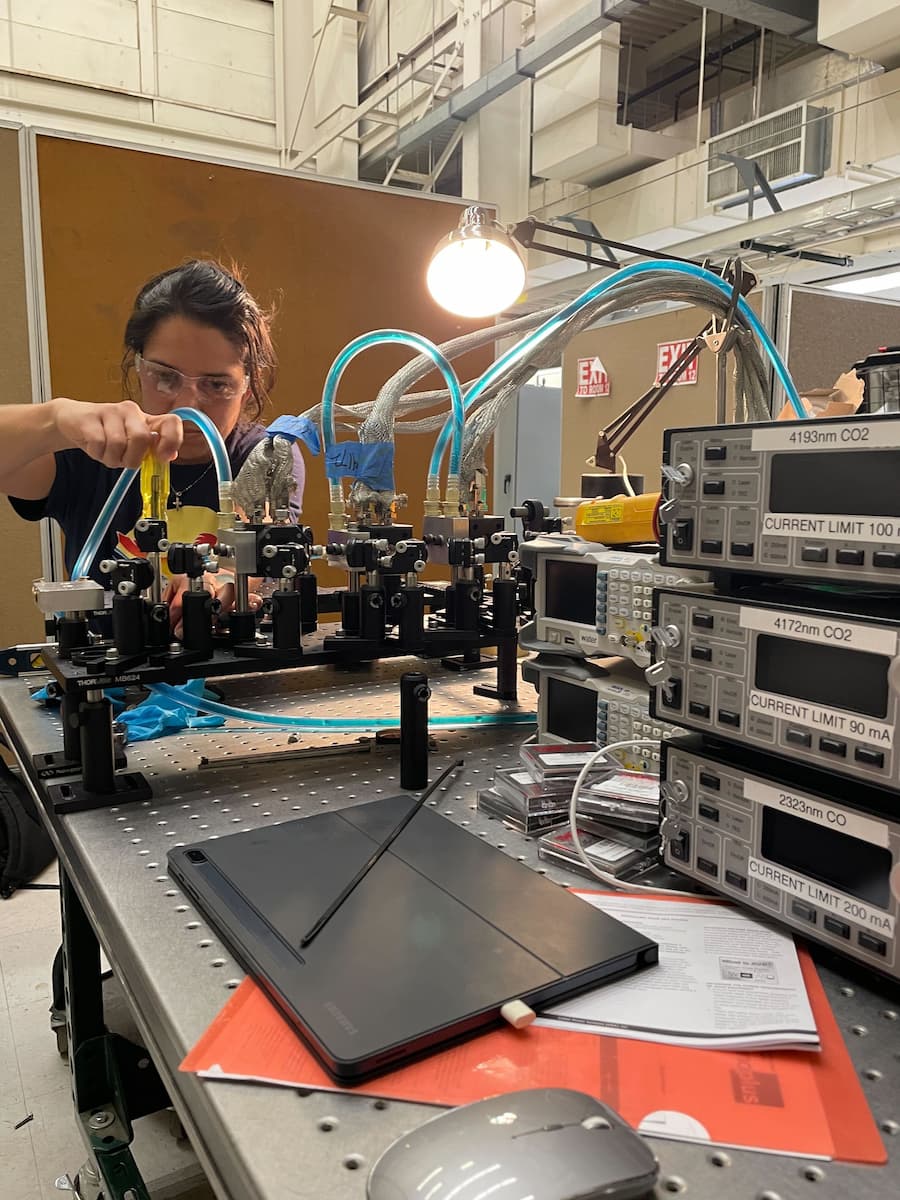 “I feel like everybody is very curious and what we do is fascinating and I would never want to discourage someone by being impatient or not explaining things,” Martinez said. “I’m a big believer in mentorship and not just from the professional standpoint but from the personal. We’re human, but the work we’re doing requires delicacy for it to be correct.”
She is currently working with the team that is developing rotating detonation rocket engines. These engines are intended to replace traditional rocket engines in many applications as, theoretically, they use propellant more efficiently, so they can be smaller and help a vehicle carry a greater payload. However, they also burn hotter.
“Our goal is to create a ‘map’ from our testing which allows scientists to create simulations and to understand what kind of temperatures the materials might be experiencing,” Martiez said.
Once she earns her master’s, she said the natural progression would be to go into the aerospace industry, however she is also considering pursuit of a Ph.D.
“I sincerely did not think I would be here,” Martinez said. “But I want to be an example that we can succeed. Sí se puede. It’s hard, but there are a lot of people here who come from hardship. And because they come from hardship, that encourages them to be someone who’s helpful and eager to see you succeed.”
— Sean M. Wood
