
Posted on February 16, 2026 by Department of Mechanical, Aerospace, and Industrial Engineering Staff
 Herta P. Montoya, assistant professor in the Department of Mechanical, Aerospace and Industrial Engineering at The University of Texas at San Antonio is one of the latest faculty hires in the department. She earned her Ph.D. in Civil Engineering from Purdue University in 2024.
Herta’s work advances the development and assessment of cyber-physical systems and digital twins to enhance infrastructure resilience, advance space systems, and support intelligent technologies. She has authored more than ten papers in top journals— including the AIAA Journal, Acta Astronautica, and Journal of Engineering Mechanics—and was interviewed for The Wall Street Journal article “How to Build a Home on the Moon.”
Read the Q&A with Dr. Montoya below!
-
What courses you intend to teach?
Dynamics Systems and Control (ME 3543), Engineering Design Optimization (ME 3833), and other advanced control courses. -
What attracted you to become an engineer?
I was drawn to engineering because it allows you to turn ideas into reality: to dream up a project, design it, and build it. Growing up, I watched my dad, an engineer, approach challenges with creativity and passion, and that early exposure sparked my own love for problem-solving. -
What kind of qualities do you look for in an engineering student(s)?
I look for curiosity and creativity above any specific technical skill. A genuine desire to learn new things and explore ideas is what fuels growth. I believe that passion for what you do drives inspiration, persistence, and ultimately excellence. -
Do you have an engineer that you consider a role model, and why?
My role model is my dad, a civil engineer who truly loved every part of his work — from conducting studies and designing solutions to seeing infrastructure projects come to life. He always strived to give his best, going the extra mile and reminding me that engineering is ultimately about serving others. His example taught me that engineering has the power to make a real, tangible difference in people’s lives. - What is one famous engineering project you would have loved to be apart of?
I would’ve loved to be part of the design of the International Space Station (ISS)
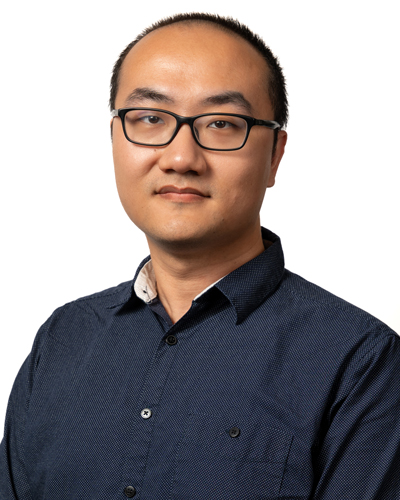
Binghan He, assistant professor in the Department of Mechanical, Aerospace and Industrial Engineering at The University of Texas at San Antonio is one of the latest faculty hires in the department. He earned his Ph.D. in Mechanical Engineering from the University of Texas at Austin.
Binghan studies the design, modeling, and control of human-in-the-loop robotic systems. He has published in top journals, including IEEE Transactions on Automatic Control and IEEE Transactions on Neural Systems and Rehabilitation Engineering.
Read the Q&A with Dr. He below!
-
What courses do you intend to teach?
I intend to teach courses in robotics and control systems and to develop advanced electives in design, modeling, and control of human-in-the-loop robotic systems that integrate theoretical and experimental learning. -
What aspects of engineering do you find most rewarding or exciting?
I find it most rewarding when engineering bridges theory and real-world applications. In my work on human–robot interaction, exoskeletons, and medical robots, it is exciting to see control algorithms and mechanical designs evolve into systems that directly enhance human capability, safety, and performance. The process of turning abstract models into intelligent machines that work seamlessly with people is both intellectually challenging and deeply meaningful. -
What kind of qualities do you look for in engineering students?
I look for curiosity, persistence, and the willingness to learn from failure. Strong technical skills are important, but what stands out most is a student’s drive to understand why something works, not just how. I also value teamwork and communication, since robotics engineering problems often arise at the intersection of multiple disciplines. -
How do you build and collaborate with people outside the engineering field?
Robotics is inherently application-oriented and relies on collaboration across multiple disciplines. We build strong partnerships by engaging collaborators early, defining shared goals, and maintaining open communication among engineering and non-engineering teams. In studies of human-in-the-loop robotic systems such as exoskeletons and medical robots, this approach is especially crucial as engineers, scientists, and medical experts work together to understand user needs, bridge knowledge gaps, and design effective systems. -
Are there any clubs, or internships you found especially helpful for your career?
Hands-on experiences were the most formative, especially those that combined mechanical design, programming, and real-world testing. During my undergraduate years, research projects and engineering work in labs and EPICS teams were invaluable. They strengthened teamwork, problem-solving, and system integration skills, and helped me connect theory to practice while tackling complex, open-ended challenges. -
In your opinion, what is the most exciting technological advancement on the horizon in your industry?
The most exciting advancements are in machine learning and AI, which allow robots to learn and adapt in dynamic human environments, and in material science and engineering, where new sensors and actuators are making robots more lightweight, responsive, and safe to interact with.
— Department of Mechanical, Aerospace, and Industrial Engineering Staff
