
Posted on April 21, 2026 by Sean M. Wood
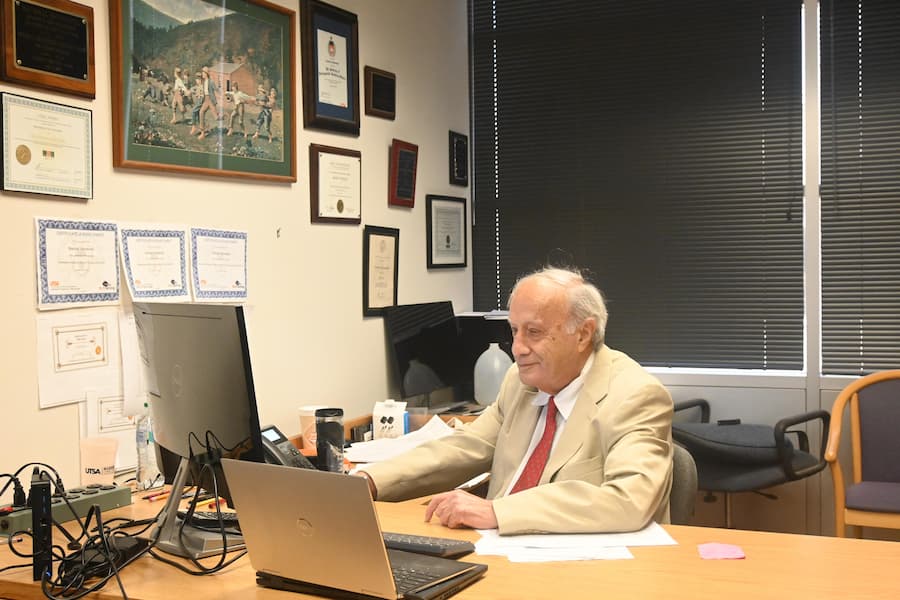
Karimi sitting at his desk.
Dr. Amir Karimi’s story is stacked in his cramped office in the Engineering Building. Anything with a surface is jammed with 44 years of memories and materials dating back to 1982 when he was hired as the University of Texas at San Antonio’s first professor of mechanical engineering.
Textbooks and reference materials — some even predating that time — are wedged into the floor-to-ceiling bookshelves running the length of the room. Karimi has just enough space to easily get around his desk to sit at his computer with double monitors. His multipurpose printer balances atop a file cabinet. Karimi’s wall is covered with plaques, accolades, and certificates marking his professional affiliations.
“You see all these papers?” Karimi asked. “I have to clean this office and then I clean my house where I have more papers.”
The collection of information is daunting given the trove of texts he is nestled within. But what is more staggering is the knowledge leaving with Karimi, and not just in the field of thermodynamics, his area of specialization.
His fingerprints are on everything engineering and nearly as much related to the university. Karimi is one of the architects of the Klesse College’s successful accreditation reviews. He drafted much of the mechanical engineering curriculum. He taught those first classes and equipped the department’s laboratories. That’s just scratching the surface.
As an engineer, he has secured more than $1 million in grants in the last 15 years, been published hundreds of times in peer-reviewed journals and conference presentations and developed dozens of classes during his career.
Karimi is a fellow and lifetime member of the American Society of Mechanical Engineers (ASME), a fellow and lifetime member of the American Society for Engineering Education (ASEE), and a lifetime member of the American Society of Heating, refrigerating and Air-Conditioning Engineers (ASHRAE).
“Someone like Dr. Karimi, who has been here for 44 years, has probably seen it all in terms of the growth of the university and the growth of the mechanical engineering program, and has a wealth of experience in terms of teaching, research and service,” Zachry Mechanical Engineering Department Endowed Chair Dr. Ender Finol said. “I sometimes wonder if we, being younger and being of a different generation, should probably have asked him for more advice, especially on administrative decisions, and when it comes to the curriculum.”
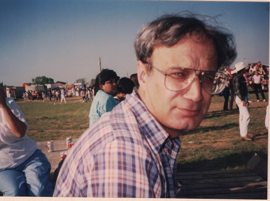
Accreditation Expertise
Karimi’s curriculum vitae has page after page of examples of volunteer work performed for the college, the program, and the university. These include committees he’s chaired, subcommittees on which he’s served, task forces and work groups. But there is one thread that seems to run throughout his narrative — ABET.
The 94-year-old organization was known as the Accreditation Board of Engineering and Technology. It’s The group of examiners evaluate a variety of programs to determine if they are worthy of accreditation. It was important to the fledgling engineering department that it receives accreditation.
He was charged with securing accreditation for the three engineering programs — mechanical, electrical and civil. However, there were enough deficiencies to keep the programs from becoming accredited.
“When I was back as department chair, I had to fix those problems,” Karimi said. “When they came back three years later, they saw that we had addressed the issues they raised and we got accreditation.”
Karimi wanted to understand the process from the inside. So, he became an ABET evaluator. He has completed 29 evaluations at other institutions including 11 as team chair. That experience helped him lead the accreditation efforts for the entire Klesse College of Engineering and Integrated Design.
“I’m probably more knowledgeable in ABET than anybody else here,” Karimi said.
Adapting to the Situation
Karimi was the architect of the mechanical engineering program. Over his career he developed dozens of undergraduate and graduate courses. He taught dozens of classes and was the curriculum coordinator for at least 20 classes.
There was no college of engineering. Engineers were part of the College of Science and Mathematics. The five civil engineering professors on faculty were part of the environmental sciences program.
“They were happy that I applied because they gave me a course to teach,” he said.
Because he had an undergraduate degree in metallurgical engineering, he taught material sciences. Due to low enrollment in other classes, he had to teach courses where he had no experience.
“At the last minute, they told me to teach an introduction to engineering,” Karimi said. “When I took the course, we used slide rules. They were using calculators.”
He also taught manufacturing engineering. “That was something I never had taken before,” he said. “Those are dealing with machining materials, the forces, the machines. It’s completely out of my field. So, I had to learn that.”
Karimi estimates that he taught at least 17 undergraduate courses and seven graduate courses in his first few years at UT San Antonio.
“Some of the courses I taught, I had to learn myself before teaching them,” he said. “You can’t see those kinds of things happening today. Most people teach one or two courses and that’s it. But it was good because it gave me broad knowledge.”
It was also very personal. He said the classes were small, like a private school. “There were 10 to 12 students. By the second week, I knew them all,” Karimi said. “Now you go to a class of hundreds and maybe half of them don’t show up. But the whole culture has been changing. Many of them were from the local military bases and they were older than me.”

Building the Department
Karimi said the mechanical engineering faculty grew from six to 13 from 1998 to 2003 during his time as department chair.
“I tried to get people who had experience in research,” he said. “Most of them had postdocs or had worked in professional organizations. They knew how to write proposals and how to initiateresearch. Those people became mentors for the newer faculty.”
One of those was Dr. Randall Manteufel, associate professor of mechanical engineering. He worked at Southwest Research Institute when he started teaching thermodynamics part time in 1994. Manteufel became a full-time faculty member in 1997.
“He mentored me just on teaching,” he said. “I remember sitting in his office and him explaining what the department wants to see in the teaching of this course and what challenges there will be and he was spot on. He knew the challenges I would face as a teacher. I immediately had a deep respect for his knowledge and his wisdom.”
Manteufel said Karimi emphasized the basics and ensuring students grasp the fundamental concepts. “Because to build on anything but a sure foundation of those concepts is foolishness,” he said.
Through mutual respect their professional relationship became a friendship. He worked with Karimi on accreditation, and at his urging, Manteufel joined the ASEE and hosted a local conference.
“Whenever you talk to him, he’s smiling,” Manteufel said. “There aren’t a lot of professors that you can say that about.”
Leaving Campus
Karimi talks about traveling once he’s officially retired. His wife died in 2018 so it’s just him. He mentioned traveling to Europe or South America. Karimi said he also plans to visit his sons and grandchildren. One son is in Austin and the other is in Denver.
He also has friends in Portland, Ore. Karimi and his wife studied at Oregon State University which is about 90 minutes south of Portland. He already had plans to go to Portland for a friend’s funeral. “Every time I go there, the number of people I visit are less and less,” he said.
Karimi also said he plans to stay active. He walks three miles a day and at 79 he plays in a soccer league with players as young as 30.
He coached his sons while working toward his Ph.D. in mechanical engineering at the University of Kentucky in Lexington, Ky. Once he graduated, he said the locals wanted him to coach at the high school. “I had already invested too much time in my degree, so I turned them down,” Karimi said.
He said he still has the skills he had when he was a young man. He just can’t perform them.
“You know how to kick. You know how to trap the ball. You know how to the pass the ball correctly,” Karimi said. “But when your mind tells you to do something, your body doesn’t bother with it.”
He compares teaching to coaching and said he believes there has been a change in student attitudes.
“In coaching, you need the people to practice hard and follow your instructions,” Karimi said. “I think the students I had a long time ago, they probably appreciated me more, much more than the students I have taught the last few years. I was a demanding teacher.”
Manteufel agrees that Karimi was demanding. “But I believe even some of those students who did not earn a passing grade would come back and say it was on them.”
— Sean M. Wood
