
Posted on April 23, 2026 by Sean M. Wood
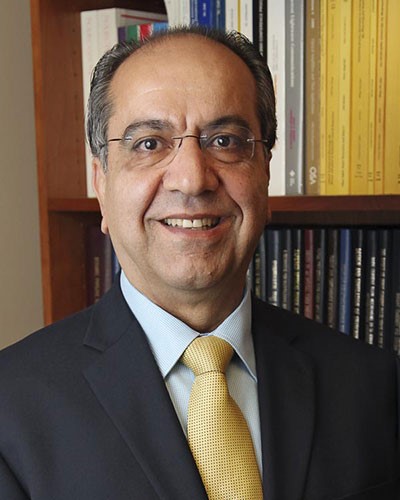
The way Dr. Mehdi Shadaram tells it, he was just passing through San Antonio when he dropped by the University of Texas at San Antonio to see if the school of engineering had evolved.
“I think I passed through San Antonio and saw how UT San Antonio was growing compared to 40 years before,” the Janey and Dolph Briscoe Distinguished Professor of Electrical Engineering said. “I really like San Antonio. It’s one of my favorite cities.”
It was 2003 and Shadaram was in his 19th year teaching electrical engineering at the University of Texas at El Paso. He was established, a classroom favorite. But UT San Antonio was hiring a chairman for the department of electrical engineering. “I applied and that’s how I came here,” he said.
The university and the school of engineering were on an upward trajectory which Shadaram helped drive. He contributed by starting a computer science degree with a master’s program. Once that was approved, he suggested the name of the department change to Electrical and Computer Engineering. “It was very trendy in those days,” he said.
Beyond the trends, the college of engineering was evolving, according to Shadaram. He said there was one doctoral program when he arrived, but today there are six doctoral programs, 13 master’s programs and nine undergraduate programs in the Klesse College of Engineering and Integrated Design.
“That is just one dimension to look at,” he said. “The same goes for growth in research spending.”
Shadaram had a $500,000 research grant that he brought with him to UT San Antonio. That one grant, however, was just the start. In 20 years, projects where he has been principal investigator or co-principal investigator have yielded more than $10 million in research funding. Funders include NASA, the Jet Propulsion Laboratory, the National Science Foundation, Office of Naval Research, Department of Defense and more. Much of the work was technical, related to his research in fiberoptics. But there was also a significant amount of research for many of these same clients that was occupational.
“At that time, the STEM issue was hot, even at the national level,” Shadaram said. The university and these agencies wanted to get more women and minorities into the fields of science, technology, engineering and math.
His work with one NSF project, research experience for undergraduates or REU, seemed applicable to UT San Antonio.
“Most of the students we had were from low-income families and they had to work outside campus and that was one of the obstacles,” he said. “It didn’t let them stay on campus and interact with their classmates or professors. My goal was to keep these students on campus so they can interact with faculty or interact with other students. So, we created a stipend which is how we encourage them to participate in research labs.”
That eventually became the Center for Excellence in Engineering Education (CE3). Shadaram is the director and he directs grant money toward student support.

“He has always been deeply committed to supporting students,” former Department Chair Dr. Chunjiang Qian said. Under his leadership, the CE3 provided strong support for students through summer programs and REU opportunities. Dr. Shadaram helped supplement the college’s support and benefitted numerous students who are interested in research. His generosity and student-centered leadership have left a lasting impact on the department and college.”
Interim Department Chair Dr. Yongcan Cao, the Mary Lou Clarke Endowed Distinguished Professor of Electrical Engineering said Shadaram personally supports anywhere from five to 10 undergraduate students per year through the center. He is also the undergraduate advisor of record.
“I have learned a lot from him about undergraduates,” Cao said. “Even how to mentor students.”
Cao said Shadaram was very supportive of him taking the role of interim department chair. “Even after taking the role, he still handles a lot of the undergraduate mentoring, so I don’t have to worry too much,” he said.
Cao said the department will miss his responsiveness and constructive feedback. That includes the students. “Even sometimes if it’s not favorable,” Cao said. “They might not get the answer they wanted, but they will know his response quickly so they can find another option.”
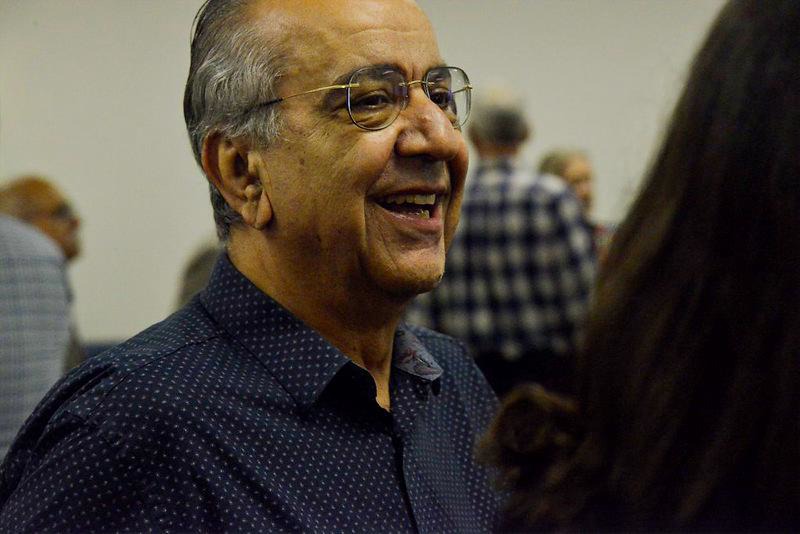
Once Shadaram retires at the end of the summer, he said he plans to finish a book he started years ago about fiber optic communications. The publisher was nice enough to put the project on hold and let him keep the advance.
“I’ve finished like six or seven chapters,” he said. “But I don’t see myself as a qualified person to write the chapters on new problems.” He’s trying to recruit two Ph.D. graduates in machine learning to co-author those new chapters.
Otherwise, he and his wife will spend time in a little house they own in a tiny village on the southern tip of Italy.
“It is a little village,” he said. “The fruit I buy is grown by the man I buy it from, just like the vegetables. Then if I want, every day, I can take a nap in that little house.”
— Sean M. Wood
