
Posted on June 19, 2026 by Ender Finol and Maria Bolanos Moreno
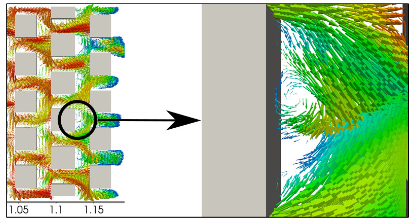
DNS of flow over rought-surfaces at high Reynolds number.
The lab is led by Dr. Kiran Bhaganagar, whose research focuses on the development and application of high-fidelity computational tools for turbulent flows, with particular emphasis on atmospheric and environmental fluid dynamics, aerial drone aerodynamics, and the dispersion of chemical gases in complex environments.
Current research areas include:
Rotating Detonation Engine (RDE)
In collaboration with AirForce Research Laboratory, we are developing next-generation predictive frameworks for rotating detonation engines (RDEs) and high-speed reacting flows relevant to advanced aerospace propulsion systems. Using advanced simulation tools such as PeleC, adaptive mesh refinement, and AI-driven reacting-flow models, the team is working on the understanding, stability, efficiency, and predictive capability of detonation-based propulsion technologies for space propulsion problems. The specific scientific questions that we are addressing are: What are the dominant physical mechanisms governing deflagration-to-detonation transition in rotating detonation environments? How do turbulence–shock and turbulence–flame interactions influence detonation initiation, propagation, and stability?
Rocket Plumes and Ejection of Fluids in Vacuum
Funded by NASA, this research initiative aims to address fundamental scientific and engineering challenges associated with rocket plume propagation in vacuum environments and plume–surface interactions during lunar landing operations. The research investigates key scientific questions related to plume expansion, shock formation, rarefaction effects, regolith erosion, particle entrainment, and dust transport under extreme low-pressure conditions. Advanced numerical tools including SPARTA DSMC Solver, PeleC, adaptive mesh refinement, and high-performance computing are used to study the multiscale interactions between plume dynamics, vacuum flow physics, and lunar surface processes relevant to future lunar landing and space exploration missions.

(middle), and pressure (bottom) obtained from the high-fidelity
simulation of RDE.
Turbulent Simulations Over Complex Surfaces
We develop novel Direct Numerical Simulation (DNS) and Large-Eddy Simulation (LES) tools to simulate turbulent flows over complex surfaces to investigate turbulence generation, coherent flow structures, surface roughness effects, buoyancy-driven flows, and turbulent transport mechanisms in complex atmospheric and engineering environments. Key scientific questions include how surface heterogeneity, roughness elements, thermal stratification, and buoyancy influence turbulence production, shear-layer development, mixing, and momentum and heat transport across multiple spatial and temporal scales. Advanced high-fidelity numerical simulations and high-performance computing are utilized to improve the physical understanding and predictive modeling of turbulent flows relevant to atmospheric boundary layers, urban environments, environmental flows, and aerospace applications.

in vacuum.
— Ender Finol and Maria Bolanos Moreno
This article was written by Ender Finol and Maria Bolanos Moreno
