
Posted on August 3, 2026 by Sean M. Wood
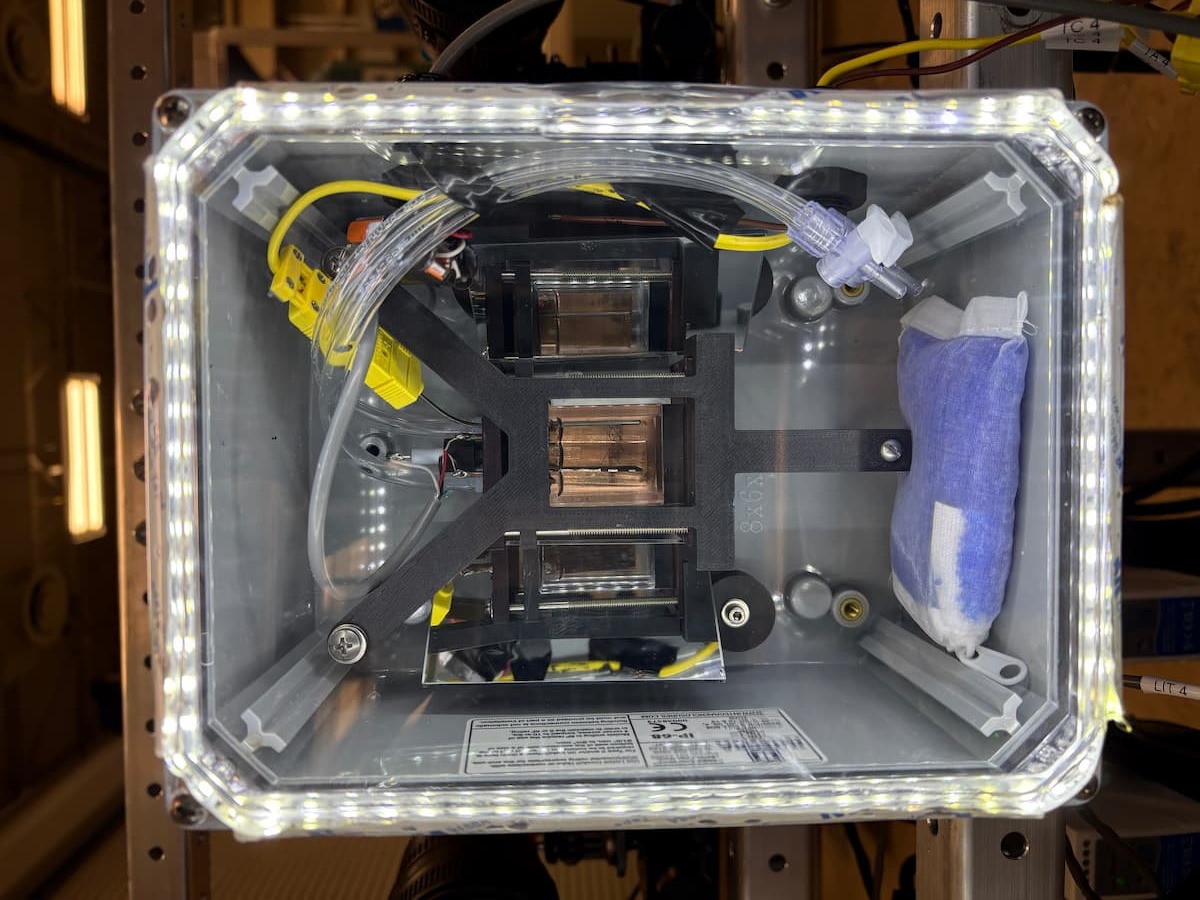
UT San Antonio and Southwest Research Institute designed this low temperature test rig for an electrolysis-based astronaut support system for Mars missions. This system has received an award from NASA for testing it aboard a parbolic flight simulating the gravity on Mars.
Officials at NASA recently told Dr. Shrihari Sankarasubramanian he was cleared for takeoff, just not for space. Sankarasubramanian will be flying on an airplane following a flight profile designed to simulate Martian gravity to test the electrolyzer he has been developing with partners at Southwest Research Institute (SwRI).
The two institutions have been collaborating to develop the device that would use local resources on the Moon or Mars to produce fuel, oxygen and other compounds vital for survival in space. Producing them at the destination reduces the need to bring it as cargo and leaves more room for research equipment.
 “NASA saw a lot of promise in the technology that we've been developing, and it’s been a whirlwind eight months to get to this point,” said Sankarasubramanian, assistant professor in the Department of Biomedical and Chemical Engineering.
In addition to building the electrolyzer, the team had to build the device’s payload for the flight test. There are a monitoring system, cameras, and controls to match -20 Celsius, near the average temperature on Mars. The flight will simulate Martian gravity for short period of time by flying up and down in a parabolic flight path. “You need the system to be robust and record everything that you need,” he said. “But it is in those seconds when you are experiencing Martian gravity.”
This test flight is just the latest in a long line of milestones Sankarasubramanian and team have achieved since the idea was first conceived.
“Five years ago, with one of my students, we came up with a plan on paper to take Martian atmospheric carbon dioxide and create these chemicals that we need at Martian ambient conditions,” said Sankarasubramanian. “We showed that it was feasible and got our first grant to develop proof of concept in 2022. We have been working with industrial partners and received multiple NASA grants that let us experimentally demonstrate carbon dioxide conversion to hydrocarbons at Martian conditions. The key metric left was to test it under Martian gravity conditions. We joined forces with a great SwRI team that has a lot of experience in reduced gravity parabolic flights and were selected as a winner in a NASA TechLeap Prize competition to do that. Now it's time to get on an aircraft and see how our electrolyzer behaves under stimulated Martian gravity conditions.”

He expects the flight to be like a massive roller coaster ride that will generate an immense amount of valuable data to move the project forward. He also wants more people to understand that this work is being done locally.
“I want people thinking about how we establish a sustainable presence on Mars and there are people here working to support astronauts who would be the first astronauts who would land up there,” Sankarasubramanian said. “I find all this cool and it’s happening at the Klesse College of Engineering at UT San Antonio. Undergraduate or graduate students should want to come here because they can get their hands on it and be part of it.” Klesse College Chemical Engineering PhD student and Klesse PhD Scholar, Vijay Vaiyadurai and Postdoctoral Fellow Dr. Sheikh Imran Uddin Ahmed (UT San Antonio Biomedical Engineering PhD, 2025) are part of the UT San Antonio team working on this project.

This project was funded in-part by The University of Texas at San Antonio, Office of Research and Southwest Research Institute.
— Sean M. Wood
Additional links:
