
Posted on September 1, 2026 by Sean M. Wood

Crystal Holland
Mechanical engineering major Crystal Holland makes no bones about her struggles with drugs and alcohol. “I got sober Aug. 4, 2020.”
Holland has used her past addiction and current recovery journey to inform her senior design project — an automatic naloxone dispenser. The brand name for naloxone is Narcan. It is an opioid antagonist that acts rapidly to reverse an opioid overdose.
“It’s really important to have it,” she said. “If any students are getting anything from the streets, there’s a good chance there’s fentanyl on it.”
Fentanyl overdoses have been declining nationally according to research conducted by Holland and her teammates. That’s not the case in Texas. The state’s opioid crisis is driven by higher overdose rates among Hispanics, according to her team. Hispanics make up 40% of the state’s population.
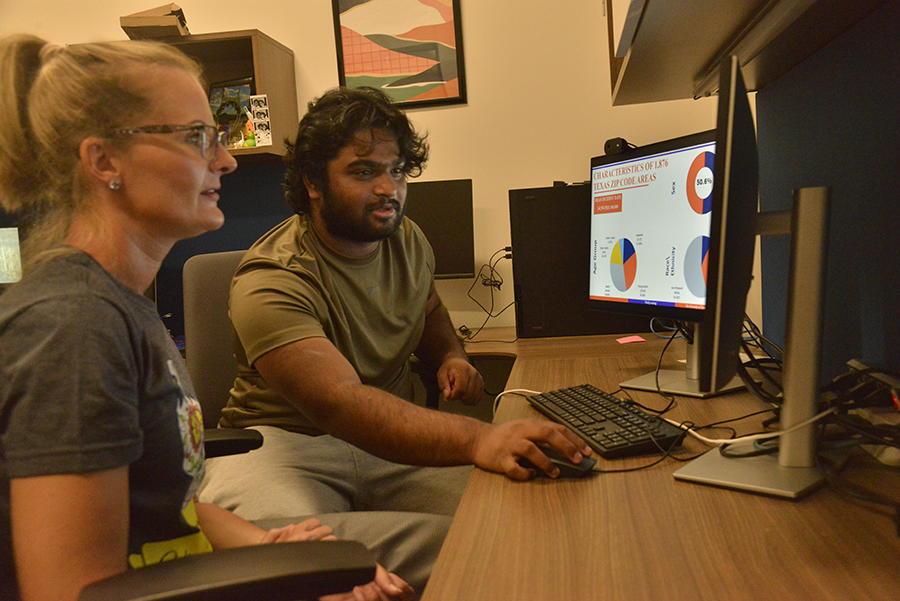
The naloxone dispenser is just one way Holland has connected her recovery to engineering. She is conducting statistical analysis, much in the way she would on an engineering project; to find overdose “hot spots” so she can report on trends.
Travis County, around Austin, has three ZIP codes that are “problematic,” according to Holland. Other cities with ZIP codes that concern Holland include Wichita Falls, Houston and Corpus Christi.
“We have ZIP codes in San Antonio that are cold spots,” Holland said. “So, whatever we're doing in our area is working, right? That means that we're statistically staying cold. We have a low overdose rate and ZIPs around us also have a low overdose rate.”
Combining engineering with her recovery was a goal she had since deciding to return to school for an engineering degree. The self-described math and science nerd was an engineering major following her high school graduation. But she started using.
“I had this dream to finish my engineering degree that I started a long time ago,” she said. “So, I got sober. I was in Houston in sober living and I started going to Houston Community College.”
Holland knocked out some basic courses at the college, and it was time to decide between the University of Houston or UT San Antonio. She had heard good things about UTSA. It would also mean she was closer to her son who lives in Bandera with his father.
“I needed to mend that relationship with my son and become a mom, so I came to UTSA and it ended up being one of the best choices of my life,” Holland said. “I get to be close to my son and continue this degree.”
She said the change in environment was a little dramatic going from sober living to university living. Holland credits Wellbeing Services Director Michael Vela and the school’s recovery program for helping her make the transition.
“The day that I moved up here, I had support,” she said. “The director was always mentoring me and I really needed that.”
However, that first year was hard. She said she had trouble fitting in. Holland was twice as old as her classmates. She also wasn’t sure she could balance recovery with her engineering degree.
Holland said she was about to give up and become a social work major. That’s when she heard about a $1 million grant secured by Dr. Carolina Vivas-Valencia, assistant professor of biomedical engineering. The grant was awarded so she and her team could develop machine-learning models on buprenorphine adherence, the drug given to people in opioid treatment. Holland was in a different lab at the time, but she had only been there for about a week.
“We both agreed Dr. Carolina’s lab would be a better fit for my interests,” she said. “Dr. Carolina has been such a blessing and believed in me from the very beginning. She accepted me and my past without hesitation, and because of that, I’ve had opportunities I never imagined.”
Valencia said Holland approaches her work with the mindset of “doing good by doing good science.”
“That philosophy is reflected in both the quality of her research and the passion she brings to it,” Valencia said. “She is motivated by a genuine desire to positively impact our community, and that sense of purpose translates into dedication, intellectual curiosity, and a strong work ethic that make her a valuable member of our team.”
Holland is making the most of her sobriety. At 40, she was worried how students nearly half her age would treat her. But some of them affectionately call her, “Miss Crystal.”
She is a Valero Scholar, earning the inaugural Valero Roadrunner Rise Scholarship that was established last year. Holland was just one of five engineering students and one of 10 students overall to earn the award.
“I want people to see that recovery is possible,” Holland said. “Sometimes I wonder if this is really happening. There is the Crystal now and the Crystal that used to be addicted to drugs and alcohol. I never had anyone try to help me. Students who are addicted to drugs and alcohol can get sober and get help now. They don’t have to go 20 years down the line.”
Holland is scheduled to graduate in the fall and plans to pursue a Ph.D. in biomedical engineering starting in the spring of 2027.
— Sean M. Wood
