
Posted on September 10, 2026 by Sean M. Wood
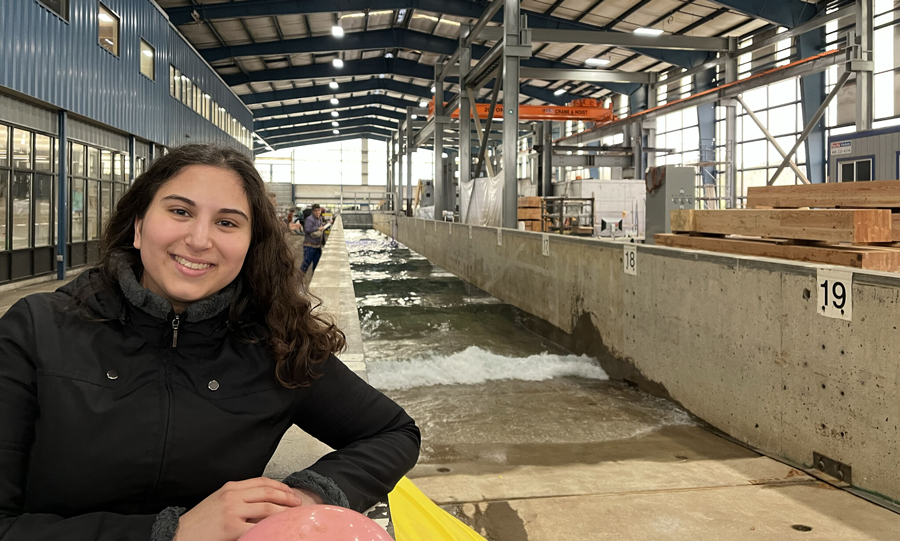
NHERI REU student poses next to a wave flume at the Oregon State University NHERI Wave Research Laboratory
Natural disasters are becoming more disastrous and therefore, more expensive.
The destructive power of earthquakes led to efforts in the last century to create better processes for designing earthquake-resistant buildings and infrastructure. Over the years, extreme events such as hurricanes, tsunamis, high winds, floods, wildfires and tornadoes have also become devastating in terms of losses to economy and well-being. The challenges and costs have accelerated over the years.
For 10 years, UT San Antonio’s Klesse College of Engineering and Integrated Design (Klesse College) has been part of the Natural Hazards Engineering Research Infrastructure, or NHERI. It is a nationwide network of 12 large-scale testing, simulation, and cyberinfrastructure facilities where researchers can simulate disasters as part of a constantly growing effort to defend against and adapt to them.
Now, more undergraduates will have the chance to test their theories and learn about disaster-resilient design. The National Science Foundation recently awarded Klesse College a grant worth more than $420,000 to launch a new research program. It will send 27 students over three cohorts from across the country to natural hazards research facilities at the University of Washington, Cal Berkeley and UT Austin.
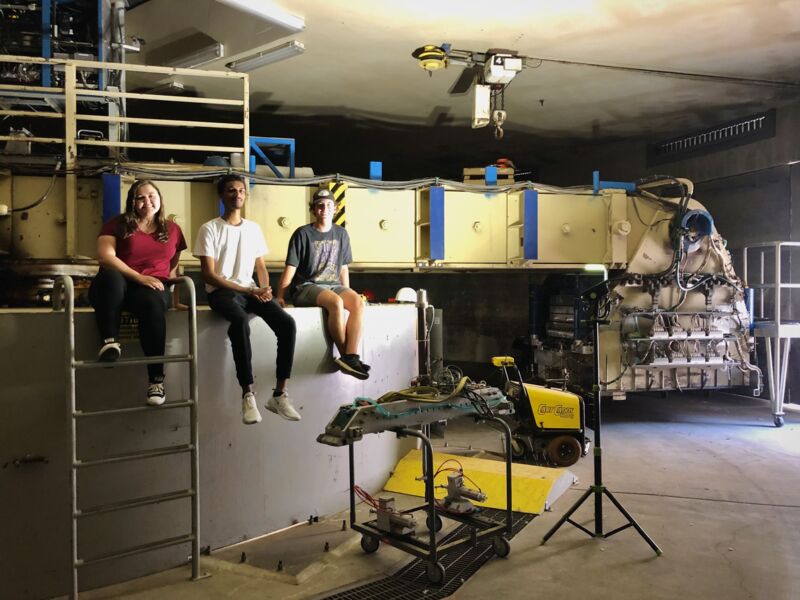
The project, called the Simulation and Technology for Resilient Outcomes in Natural Hazards Engineering and Graduate-Readiness (STRONG-R) will provide research experiences for undergraduates (REUs). It is led by co-principal investigators JoAnn Browning and Karina Vielma and research education specialist Robin Nelson. Browning is Professor and Lutcher Brown Chair in the school of civil and environmental engineering and construction. Vielma is an associate professor of biomedical engineering.
"What UT San Antonio has been intimately involved in is developing the workforce for the next generation of natural-hazards engineers and scientists," Browning said. "We've been working for the last 10 years as a natural hazards community, with NSF support, to try to help mitigate the costs of disasters to the U.S."
Yet costs keep increasing. Citing federal disaster-cost data, Browning said the five-year average cost of weather and climate disasters to the United States topped $100 billion as of the most recent published figures, in 2023. That figure only covers property damage.
"The cost of the well-being of the people can easily be twice as much as just the cost of the asset losses themselves," Browning said. “Access to water, electricity, transportation, or getting to health care are all affected. That's why we keep emphasizing: It's not just the damages, it's also that recovery period. What we're trying to do is prevent these losses from occurring."
Beyond the Money
Browning said the growing frequency and increased cost of natural disasters drive the research.
"Over the years, we've seen a growing number of natural disasters and the costs to the U.S., both in damages but also livelihood and well-being of people," she said. "Our job with this grant is to keep students engaged and help them get specialized skills so that we can encourage them to continue along the path and be able to be the professionals that design more resilient structures and infrastructure."
The work also draws students from well outside civil engineering, Browning said, including those studying computer science, data analytics, social sciences, public policy, geology and materials science.
UT San Antonio's decade of programming has hosted 226 student participants she said. Nearly 40% came from universities that aren't large research institutions, and more than half had no prior research experience before the program.
All who have participated remain in STEM degree programs or have gone on to pursue graduate degrees, and 10% are now enrolled in Ph.D. programs, she said.
"UT San Antonio is part of a large, complex organization that is training the next generation of experts who are going to make us safer from natural disasters," Browning said. “This NSF grant will help us see to that.”
— Sean M. Wood
