
Posted on September 21, 2026 by Klesse College Staff
Conversations with SA+P School Director Michelangelo Sabatino, PhD
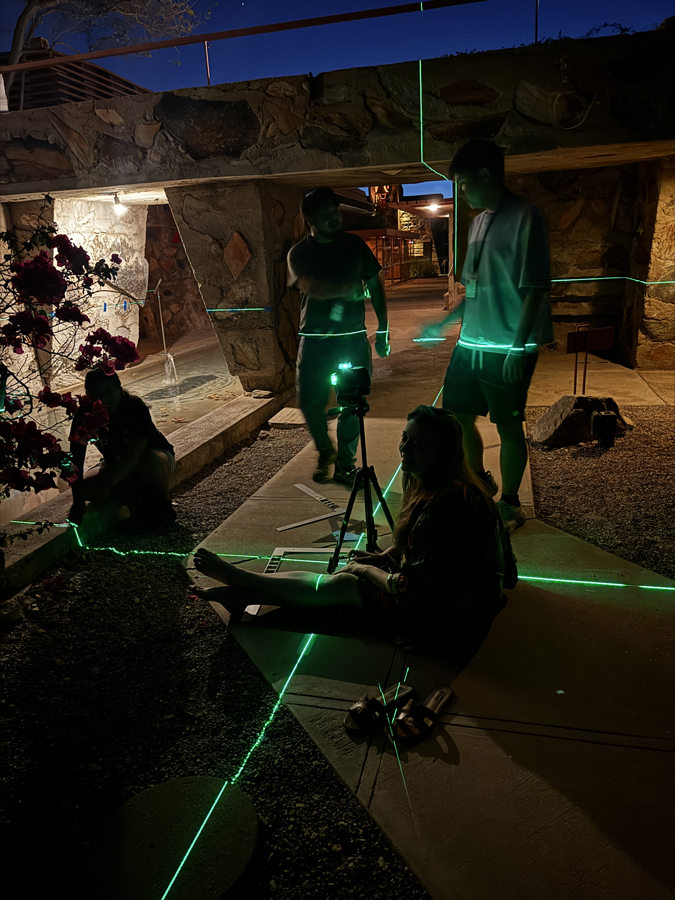
Students setting up digital level to create a datum from which to take accurate measurements.
Conversations with SA+P School Director
Every summer since 2012 Professor Sue Ann Pemberton has brought her graduate students to Frank Lloyd Wright’s Taliesin West (Scottsdale, Arizona) as part of a long-term project to produce HABS documentation (Historic American Building Survey) of the UNESCO World Heritage site. They all caravan from San Antonio and arrive in Arizona two-days later and they spend an entire month measuring, drawing, and researching one of the buildings of the historic core This past summer four students documented the Swan Cove and Wright’s personal quarters. Their collective efforts earned them Second Place in the prestigious Charles E. Peterson Competition. In October, they will all travel to Indianapolis to receive recognition and shortly their drawings will be available on the website of the Library of Congress. The four graduate students that accompanied Prof. Pemberton are: Isaac Knott, Hailey Roddie, Theresa Salazar, and Daniel Serna.
MS: This is your second visit to Taliesin West with Professor Pemberton. As a future architect what do you find compelling about the act of documenting historic buildings?
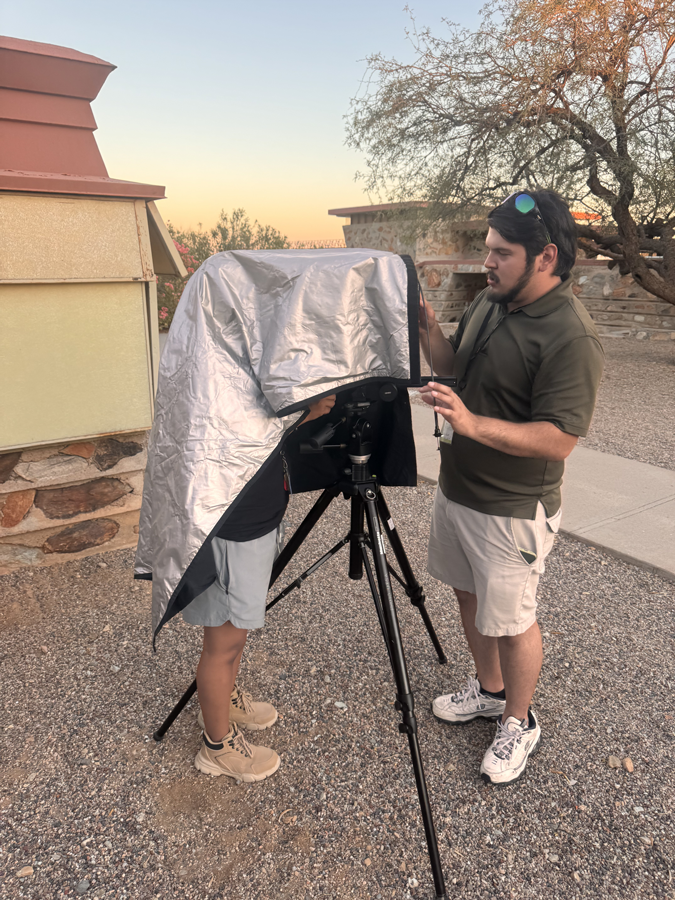
IK: I am intrigued by the act of measuring and drawing as a way of gaining tacit knowledge about a site. You can learn from structures by engaging a place for an extended amount of time. More is gained from the tactile experience than simple observation from a photograph unless you are the one who took the photograph.
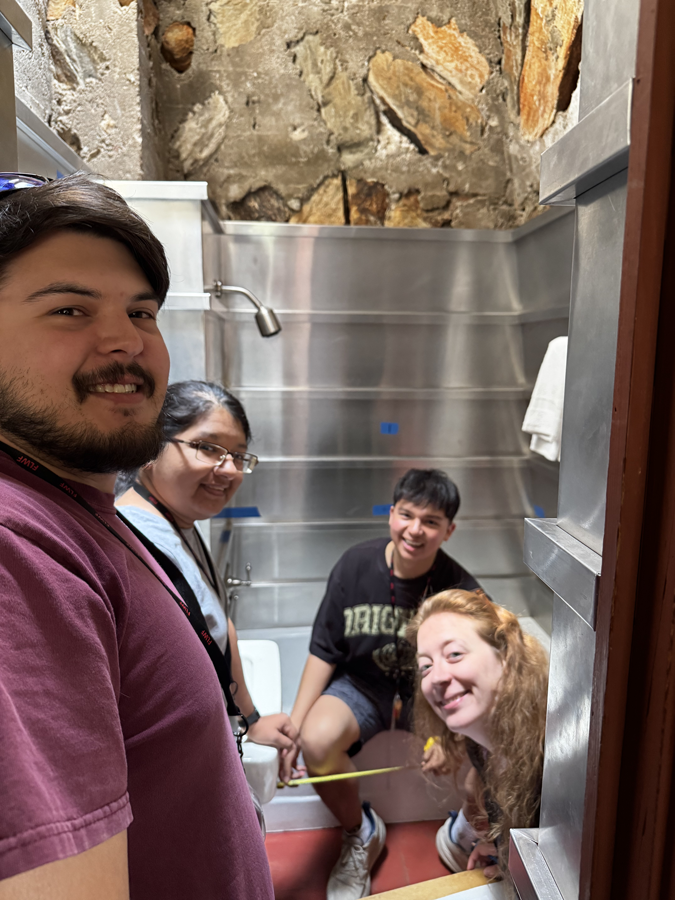
MS: You are pursuing a Preservation & Sustainability Certificate at SA+P as part of your gradudate degree MArch. How does you interest in documentation support your future identity as an architect?
IK: For me it is about continuity in architectural culture. What I mean by this is that every architect belongs to a lineage of previous practioners and we can learn alot standing upon the shoulders of giants. I am especially intrigued by Frank Lloyd Wright’s establishment of the Taliesin School and Fellowship and the culture it created.
MS. For those who do not know about the HABS program, please explain what makes it special?
IK: It is the first program designed to employ architects and draftspeople who were out of work during the Depression years. It was established to record our built heritage. It involves both measuring and drawing as well as carefully taking field notes and photographs. What is really unique about this program, especially in our current environment of digital tools, it gives us tactile and memorable experiences as well as a sense of place.

Taliesin West: Swan Cove & Wright's Bedroom
The Taliesin West complex is located within the arid, desert foothills of the McDowell Mountains in Scottsdale, Arizona. It became Wright's winter home and the academic campus for his Taliesin Fellowship. The residential core that included the Swan Cove and Wright's Bedroom were completed by winter 1940.
Since original construction of Taliesin West, multiple renovations and additions have occurred in the Swan Cove and Wright's Bedroom. In 2003, the quarters were restored back to their original appearance during Frank Lloyd Wright's lifetime.
The Swan Cove and Wright's Bedroom represent Frank Lloyd Wright's Organic Architectural ideologies and principles. Wright incorporates sustainable elements and features throughout the design in reference to the natural environment, inhabitants, and context. Wright and his apprentices built Taliesin West between 1937-59, a period often referred to as Wright's “Second Golden Age.”
The Taliesin West complex is located within the arid, desert foothills of the McDowell Mountains in Scottsdale, Arizona. It became Wright's winter home and the academic campus for his Taliesin Fellowship. The structure of the Swan Cove and Wright's Bedroom incorporates stones from the surrounding desert as exposed features of the concrete. Known as "desert masonry," the approach combined the structural benefits of concrete and the inherent aesthetic of desert materials. Historian Frederick Gutheim has written that "Tuned to nature within and nature without, man and architecture were all of a piece and never more vividly so than his own beloved places in Wisconsin and Arizona.”
Today, over 125,000 people visit Taliesin West to witness Frank Lloyd Wright's balance of the built and natural environments. The significance of Taliesin West, and Frank Lloyd Wright is not only recognized by designers and architects, but worldwide. The National Parks Service formally recognized the significance of Taliesin West in 1974 when it was listed on the National Register of Historic Places and then designated a National Historic Landmark in 1982. The city of Scottsdale added Taliesin West to the Historic Register in 2006 and on July 7, 2009 the United Nations Educational, Scientific, and Cultural Organization (UNESCO) added Taliesin West to the World Heritage.
The Frank Lloyd Wright Foundation sponsored the documentation of the Wright's Bedroom and Swan Cove at Taliesin West, conducted by students from the School of Architecture and Planning at the University of Texas at San Antonio. Gabriela Garza-Long and Matthew Wright began the field work in the summer of 2025 and Isaac Knott, Salazar, Daniel Serna, and Haley Roddie completed the fieldwork in the summer of 2026 under the supervision of Sue Ann Pemberton, FAIA, FAPT.
— Klesse College Staff
