Civil Engineering Projects
Advisors: Wassim Ghannoum, Ph.D, P.E, F.S.E.I, F.ACI, Adolfo Matamoros, Ph.D, P.E, F.S.E.I, Arturo Schultz, Ph.D, F.P.C.I, F.TMS
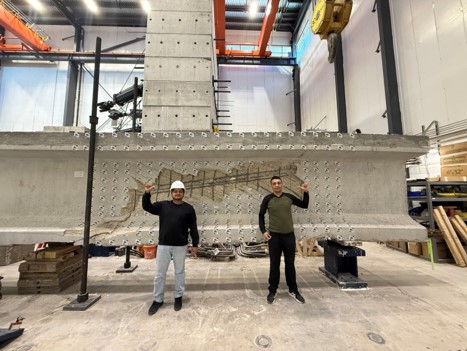
Goal: Validate performance of 300 ksi strands in pretensioned concrete girders: In shear, anchorage, flexure, and end-region cracking
Experimental Program (In Progress): Full-scale testing of 17 girders across all seven standard TxDOT I-girder sections (Tx28–Tx70), evaluated at prestress transfer and at ultimate capacity, with varying concrete strength and prestressing ratios.
Advisor: Wassim Ghannoum, PH.D, P.E, F. SEI, F. ACI
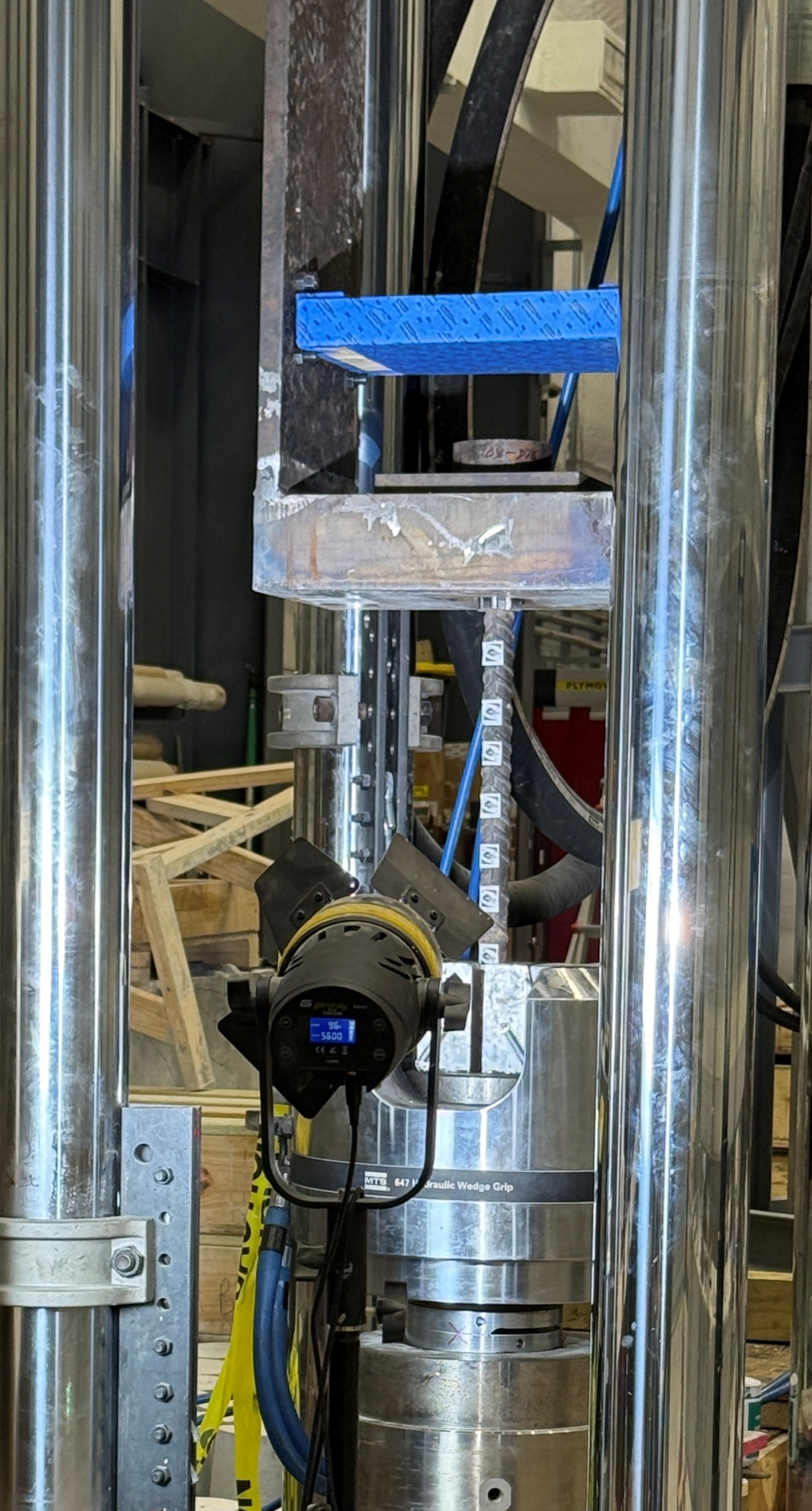
Objective: Develop QA/QC testing criteria for Gr. 80 couplers and headed bars.
Key idea: Evaluate commercially available Gr. 80 couplers and headed bars using specimens from major fabricators. and the testing procedures.
Grad-Student: Eduardo Leos, EIT
Advisor: Wassim Ghannoum, PH.D, P.E, F. SEI, F. ACI
Key idea: The fracture strain of CFRP (approximately 1%) exceeds that of rebar yield strain by several times, allowing steel to yield and dissipate energy without causing CFRP rupture when detailing is properly executed.
Experimental program: Conduct full-scale cyclic tests with systematic variations in CFRP quantity and anchorage details.
Outcome reported: Quantification of the effects of CFRP quantity and anchorage detailing on strengthening and ductility related responses.
Sponsor: Texas Department of Transportation (TxDOT)
Grad. Student: Emmanuel Zamora-Romero & Thomas Anderson
Student Lab Assistants: Carlos Vargas & Obadah Natsheh
Advisor: Adolfo Matamoros, PH.D, P.E, F.ACI, F.SEI
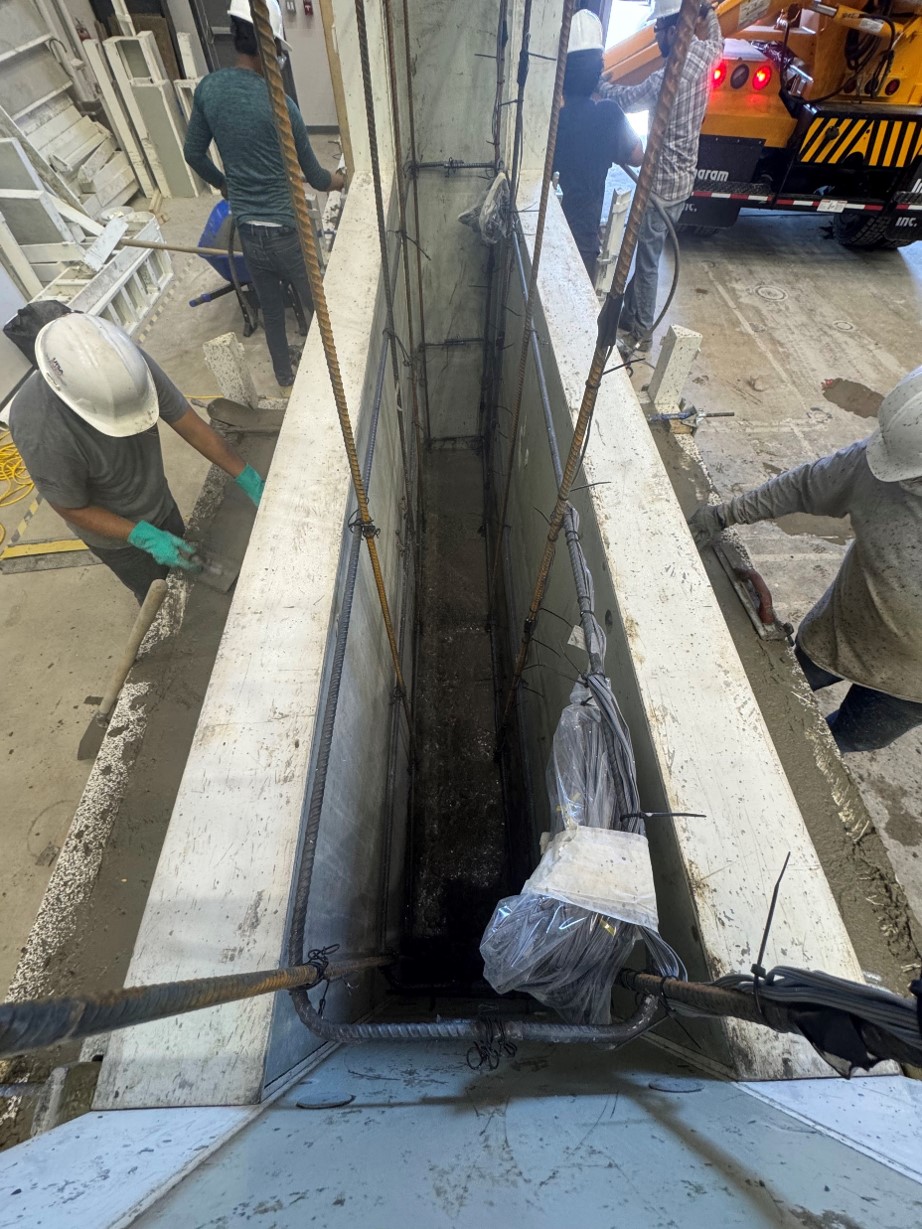
Goal: Develop clear design guidance for using hooked and headed bar attachments in TxDOT bridge structures.
Approach:
- Utilizing reinforced concrete test specimens that are representative of TxDOT bridge structures and current design practice, large-scale experimental testing of confined and unconfined beam-column joints with hooked and headed bars terminating within the joints is being performed.
- Specimens include No. 9, No. 10, and No.11 bars (60 ksi & 80 ksi)
- The test specimen configuration includes three test regions, allowing for testing of beam-column joints in single- and double-curvature.
Sponsors: Fulbright-COMEXUS, CONTEX initiative, SECIHTI, Dampo Systems, and UTSA internal funding
Grad. Student: Emmanuel Zamora-Romero
Student Lab Assistants: Thomas Anderson, Emily Martinez, Carlos Vargas & Obadah Natsheh
Advisor: Adolfo Matamoros, PH.D, P.E, F.ACI, F.SEI
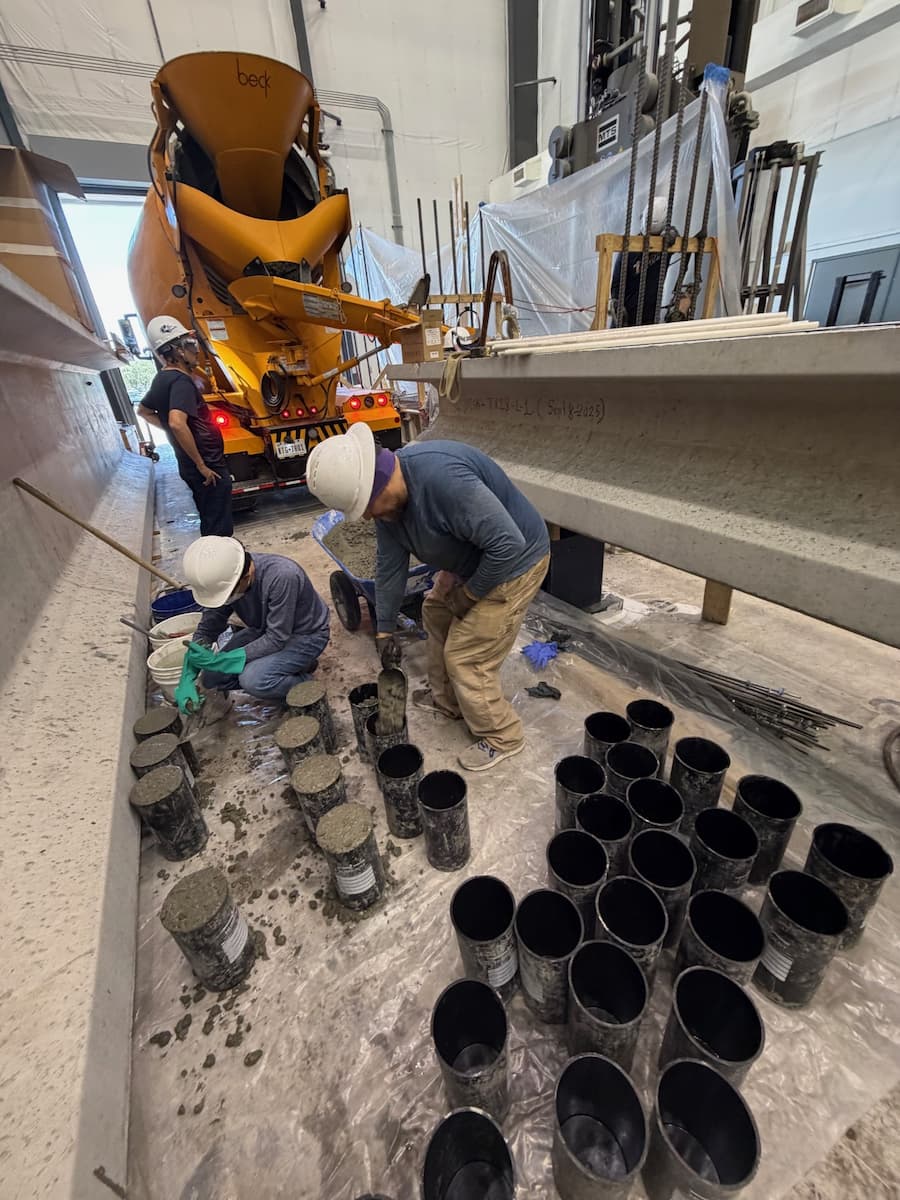
Goal: Use hybrid testing to evaluate and optimize BRB retrofitting performance in seismically vulnerable RC buildings.
Approach: Optimize BRB configurations through numerical analysis across various seismic scenarios, then validate using hybrid testing on a scaled two-story RC frame with realistic earthquake loading protocols.
Experimental/computational setup: Half-scale, 2-story RC frame with BRBs tested using 4-DOF hybrid simulation (MTS actuators + hydraulic rams), instrumented with cameras, strain gauges, and optical fiber sensors.
Sponsor: Texas Department of Transportation (TxDOT)
Grad. Student: Emily Martinez
Advisor: Adolfo Matamoros, PH.D, P.E, F.ACI, F.SEI
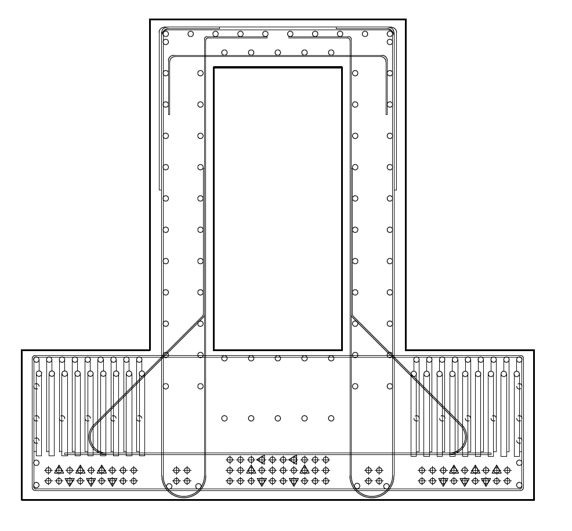
Goal: Investigate the influence of voids and prestressing steel on the interaction of shear, torsion, and bending stresses in inverted tee bent caps
Approach: Develop scaled-down inverted tee bent caps and evaluate the stress interactions through elastic analysis.
Experimental Program (In Progress): Fabricate and test scaled specimens under flexural loading to quantify stress interaction effects and create design recommendations.
Sponsor: National Science Foundation (NSF)
Grad. Students: Samir Babu Thapa & Dev Raj Paudel
Advisor: Arturo Schultz, Ph.D., F.PCI, F.TMS
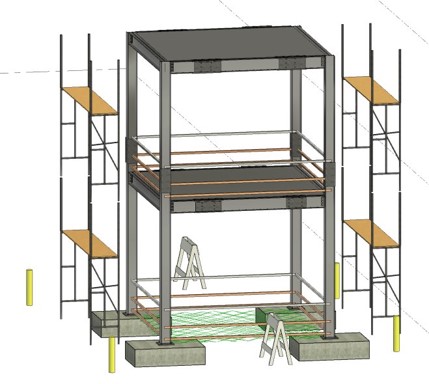
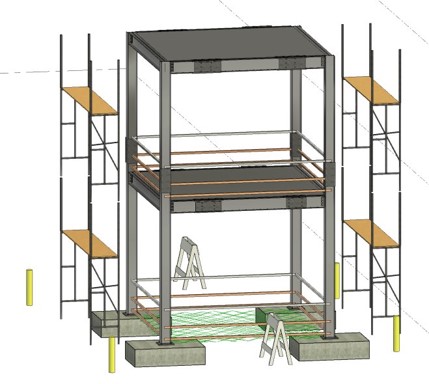
Goal: To develop, validate and evaluate an automated rapid-assembly Intermeshed Steel Connection enabling safer, faster and more sustainable steel building erection.
Approach: Design and fabrication of ISC connection system followed by full-scale gravity load testing and non-linear finite element modeling for validation and performance evaluation.
Experimental/ Computational set up: Full size, two-story, one-bay steel frame structure will be subjected to gravity loading. The structural response will be monitored using strain gages, and LVDTs. Loading will be achieved using jacks and high-strength steel bars spanning from the building floors to the lab floor.
Mechanical Engineering Projects
Sponsor: Federal Aviation Administration (FAA)
Grad. Student: Sara Restrepo-Velasquez
Advisor: Harry Millwater, Ph.D.
Goal: Enable faster fatigue crack-growth analysis for probabilistic structural assessment.
Approach: Convert variable-amplitude (VA) loading spectra into an equivalent constant-amplitude (ECA) loading condition.
Computational results: Pairing the ECA and an adaptive ODE crack-growth solver can reduce runtimes by up to ~10² while maintaining comparable predictions.
Experimental validation (in progress): Test whether the VA to ECA transformation yields the same crack-growth behavior in real life.
Experimental set up: Apply tensile cyclic loading to Al 2024-T351 specimens on an MTS Landmark frame, while measuring crack length with a traveling microscope and a crack opening displacement (COD) gage to compare the VA vs. ECA crack-growth response.
Sponsor/funding: Office of Naval Research (ONR)
Grad. Student: Viancy Catherine Isaza Zapata
Advisors: Brendy Rincon, PhD & David Restrepo PhD
Goal: The goal is to quantify how fastener installation and environmental conditions affect fatigue life. The final objective is to develop a predictive model for corrosion-fatigue in naval aircraft.
Approach:
- Link laboratory mechanical-electrochemical measurements to identify fatigue stress factor mechanisms under accelerated fatigue tests and atmospheric exposure fatigue testing
- The project combines accelerated corrosion testing, fatigue experiments, and finite element modeling. Results will be integrated into a probabilistic Bayesian predictive model.
Experimental/computational setup:
- Computational: Abaqus FEM is used to map joint/fastener stress fields and set bounds for laboratory loads and torque conditions.
- Experimental: Fatigue and corrosion are tested using “dog-bone” specimens with through-hole fasteners under controlled temperature and cyclic relative humidity, using an accelerated salt-fog electrolyte profile. Simultaneous corrosion-fatigue uses a MTS 370 Landmark load frame inside an environmental chamber with an external potentiostatfor electrochemical measurements.
Construction Science & Management Projects
Sponsor: National Science Foundation (NSF)
Grad. Student: Student: Tolulope Oyeyipo
Advisor: Ibukun Awolusi, Ph.D.
Goal: Evaluation of the impact of intermeshed steel connections on improving worker safety, assembly efficiency, and construction cost.
Approach: Experimental and simulated testing of a BIM-based model for safety performance, computer vision-based ergonomic assessment of steelworkers’ postures, and a comparative cost analysis.
Computational results: A BIM-based model of a safety integrated two-story steel framed structure, with initial results showing improvements in worker postures due to improved assembly efficiencies.